Mud rotary vs DTH drilling: which method fits your ground?
These are the two workhorse methods for water wells and production holes. Neither is 'better' — each one is better in specific ground. This page explains how they work and where each wins.
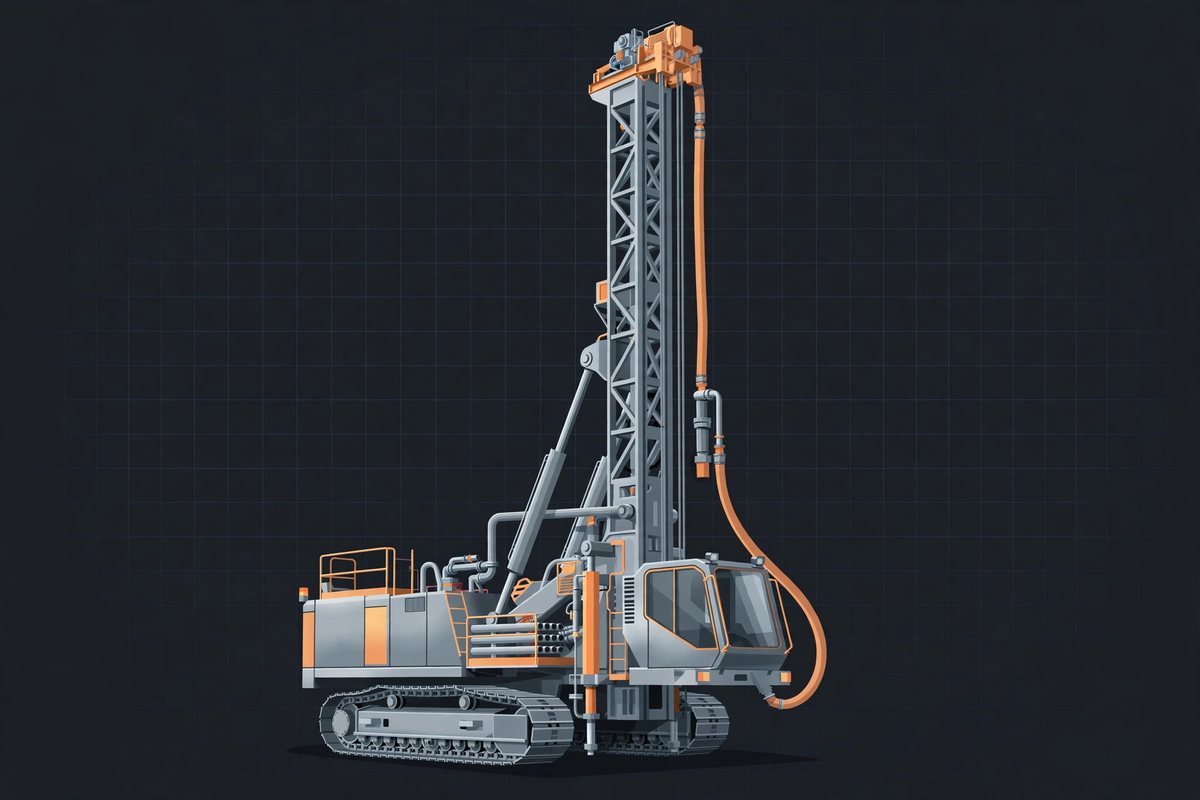
How mud rotary works
A rotating bit cuts the formation while drilling fluid ('mud') is pumped down the rods and back up the annulus. The mud does three jobs: it carries cuttings to the surface, cools the bit, and its pressure holds loose walls open until casing is set.
Mud rotary is the default for unconsolidated ground — clay, sand, gravel and soft shale — and for larger-diameter holes. Its weaknesses are hard rock (slow, bit-hungry) and mud logistics: water supply, mixing, and disposal of returns.
How DTH works
In down-the-hole drilling, the hammer sits in the hole directly behind the bit. Compressed air drives the hammer's piston and then exhausts up the hole, blowing cuttings out. Energy is delivered at the bit instead of through the whole rod string, so penetration in hard rock stays fast and holes stay straight.
DTH is the default for granite, basalt, hard limestone and bouldery ground. Its limits: it needs a compressor matched to hole depth and diameter (air volume falls as depth rises), performs poorly in soft, collapsing ground without casing, and produces dry dust that must be managed.
Side by side
| Mud rotary | DTH (air) | |
|---|---|---|
| Best ground | Clay, sand, soft shale | Granite, basalt, hard rock |
| Hole sizes | Small to very large | Typically 3–12 in working range |
| Hole quality | Can wash out in loose ground | Straight, gauge holes in rock |
| Support kit | Mud pump, pits/tanks, water | Air compressor sized to depth |
| Weakness | Slow and costly in hard rock | Soft collapsing ground; deep air lift |
In practice, many regions stack soft overburden on top of hard aquifers — mud through the top, air through the rock. That is exactly the case for a combination rig like the Aquilon 450C, which runs both methods.
Which should you buy?
- Known soft ground, wells only: a mud rotary rig is simpler and cheaper to run.
- Known hard rock: DTH, with the compressor budgeted as part of the system.
- Varied or unknown geology, or contract work: a combination rig. The premium is smaller than the cost of the first job your single-method rig cannot finish.
Blast hole work is almost always DTH — see the quarry blast hole guide. For a first rig purchase, start with how to choose a water well drilling rig.
Common questions
Which method drills faster?
In hard rock, DTH by a wide margin. In soft ground, mud rotary is fast and DTH is often unusable. Speed comparisons only make sense inside one formation.
Can I add a compressor later and convert a mud rig to DTH?
Only if the rig's rotary head, mast and rod handling are rated for hammer work. Ask before you buy — combination rigs are built for it; mud-only rigs often are not.
Which method makes a straighter hole?
DTH in rock, because the hammer and a stiff rod string keep the bit on line. Mud rotary can wander in mixed ground, especially at diameter changes.
Related: choosing a water well rig · Aquilon 450C combination rig · rods, hammers and bits
Need a quote?
Tell us the job and the location. We quote equipment and shipping together.