Geothermal borehole drilling: depths, loops and rig choice
A geothermal borehole is a heat exchanger you drill, not a well you pump. That difference drives the depth, the completion and the rig. Here is how boreholes are specified and drilled in practice.
What a borehole has to do
A ground-source heat pump circulates fluid through a sealed U-loop in the borehole, exchanging heat with the ground. The borehole succeeds or fails on three things: enough total length for the building's load, good thermal contact (grout) between loop and ground, and a seal that protects groundwater between formations.
Typical dimensions
| Parameter | Typical range | What sets it |
|---|---|---|
| Depth per bore | 200–600 ft (60–185 m) | Heat load, geology, available land |
| Hole diameter | 4.5–6.5 in | Single or double U-loop, grout annulus |
| Bore spacing | About 15–25 ft | Thermal interference between bores |
| Loop | Single or double U-loop, HDPE | Design flow and heat transfer |
These are typical design ranges, not guarantees — the system designer sizes each field from a thermal response test or local experience.
Drilling and completing a bore
- Drill with mud rotary in soft ground, DTH in rock; case unstable overburden as you go.
- Insert the U-loop as soon as the hole is at depth — open holes in bad ground do not wait.
- Grout by tremie from the bottom up, filling the annulus completely; voids are lost heat transfer and a groundwater risk.
- Log and pressure-test each loop before connecting the field headers.
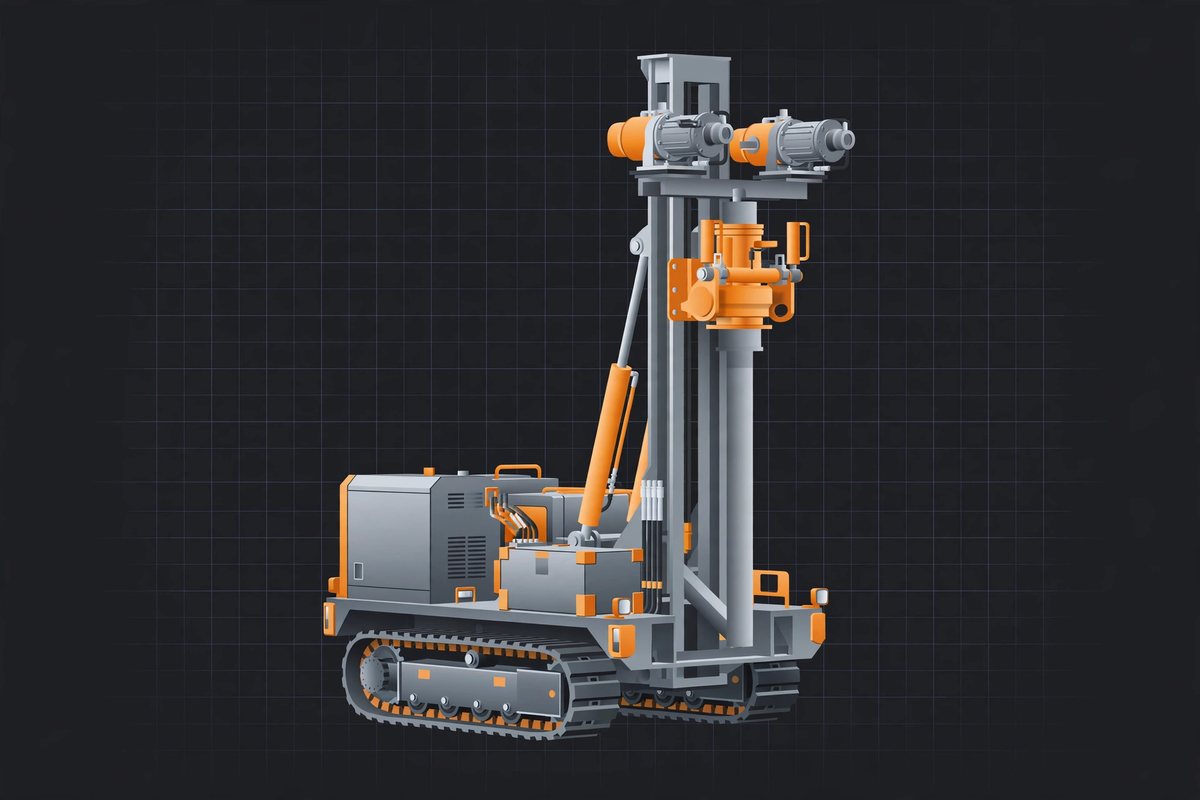
The pace of a borefield is set by this cycle repeating cleanly. Double-head rigs earn their keep here: casing and inner string advance together, so holes stay open in collapsing ground and loops go in on schedule.
Choosing the rig
Size depth with margin above the deepest planned bore, confirm the rig fits residential access (gate width, overhead lines, street parking), and check noise — geothermal work happens in occupied neighborhoods. The GeoTherm G260 is built around exactly those constraints; larger commercial fields also run the Aquilon 450C.
Common questions
How deep is a typical house geothermal borehole?
Most residential bores run 200-600 ft depending on load and geology — often several shallower bores rather than one very deep one.
Why grout the whole hole?
Grout conducts heat between the loop and the ground and seals the bore so water cannot move between formations. Ungrouted sections lose performance and can breach local codes.
Can a water well rig drill geothermal bores?
Often yes, if depth, diameter and loop handling fit. Dedicated geothermal rigs with double heads complete bores faster in unstable ground, which is where most schedule trouble lives.
Related: GeoTherm G260 · mud rotary vs DTH · geothermal applications
Need a quote?
Tell us the job and the location. We quote equipment and shipping together.